
True orthodontic emergencies are rare, but when they occur we are available to you. It is common for the braces and wires to rub the lips and cheeks. It is also very common to get small wire pokes as the teeth move and spaces close. As a general rule, you should call our office when you experience severe pain or have a painful appliance problem you can't take care of yourself. We'll be able to schedule an appointment to resolve the problem. If you have a true emergency such as trauma or infection, we have an after hours emergency line to help provide you with guidance.
You might be surprised to learn that you may be able to solve many problems yourself temporarily until you can get to our office. If there is a loose piece that you can remove, put it in a plastic bag or envelope and bring it with you to your next appointment. If your braces are poking you, put soft wax on the piece that's sticking out. If the wire has slid to one side, you can pull it back to the other side with needle-nosed pliers, replacing it in the tube on the back tooth.
After alleviating your discomfort, it is very important that you still call our office as soon as possible to schedule a time to repair the problem. Allowing your appliance to remain damaged for an extended period of time may result in disruptions to your treatment plan.
General soreness
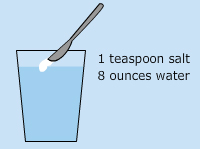
When you get your braces on, you may feel general soreness in your mouth, and teeth may be tender to biting pressures for three to five days. Stick to a soft diet until your teeth do not hurt to chew. Irritated gums and other sore spots can be relieved by rinsing your mouth with a warm salt-water mouthwash. Dissolve one teaspoonful of salt in eight ounces of warm water, and rinse your mouth vigorously. If the tenderness is severe, take Acetaminophen (Tylenol) or whatever you normally take for headache or similar pain. Aspirin, Ibuprofen (Motrin, Advil) and Naproxen Sodium (Naprosyn, Anaprox) actually slow the tooth movement, so it is not advisable to use them frequently while wearing braces.
The lips, cheeks, and tongue may become irritated for one to two weeks as they learn a new posture and become accustomed to the surface of the braces. You can put wax on the braces to lessen this. We'll show you how!
Loose retainers or appliances
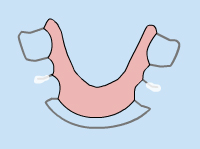
A retainer may feel tight on the teeth if it has not been worn regularly. This means that the teeth are trying to move and the retainer is applying force to prevent that movement. It is recommended to wear the retainer as much as possible for a few days, then return to nightly wear if this should happen.
If a retainer seems loose and does not feel like it is fitting properly, try to wear it if it does not cause you pain and call the office for an appointment. Many times the retainer will need to be tightened or adjusted at a routine appointment during regular business hours.
If your appliance is poking you, place wax on the offending part. Dry the area as much as possible with cotton balls or a tissue and place a large ball of the wax over the area. If an expander is loose and moving on just one side, do not activate or expand the appliance and place wax on any parts that rub. Call the office for an appointment to recement the loose side during regular business hours. Eat soft foods as much as possible on the opposite side. If an expander is completely loose on both sides, remove it from the mouth by sliding it off of both the back molars and save the appliance so it can be recemented. Call the office for an appointment to recement the appliance during regular business hours.
Loose bracket
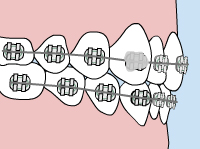
If your bracket or band is still attached to the wire, you should leave it in place and put wax on it if needed for comfort. Due to our advanced self-ligating braces, the brace will still be attached to wire. Loose brackets are not considered an emergency since the problem can be repaired during regular business hours.
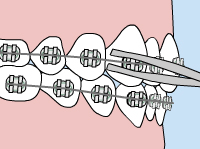
Loose wire
Using a pair of tweezers or needle-nosed pliers, try to put your wire back into place. If you cannot put the wire into a comfortable position, and covering the end with wax doesn't help, as a last resort use a small fingernail clipper to clip the wire behind the last tooth to which it is securely fastened. If the end of the wire is still sharp place a large ball of wax on it. Try to ensure the surface is as dry as possible before applying the wax so it will stick.
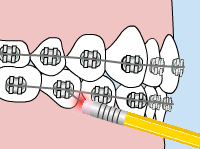
Poking wire
Using a pencil eraser, push the poking wire down or place wax on it so that it is no longer poking. Poking wires in the back of the mouth usually mean the wire has shifted over or that space is closing in the front parts of the mouth. For a wire that has slid over, try to recenter the wire by using tweezers or needle-nosed pliers to gently slide the wire. Most of the wires have a small dimple or small marking at the center of the wire to help guide placement at the center of the arch. Poking wires from space closure will require wax to keep any sharp ends covered. Try to dry the area as much as possible before applying the wax so it will stick. The wire will then need to be trimmed in the office during normal business hours.